
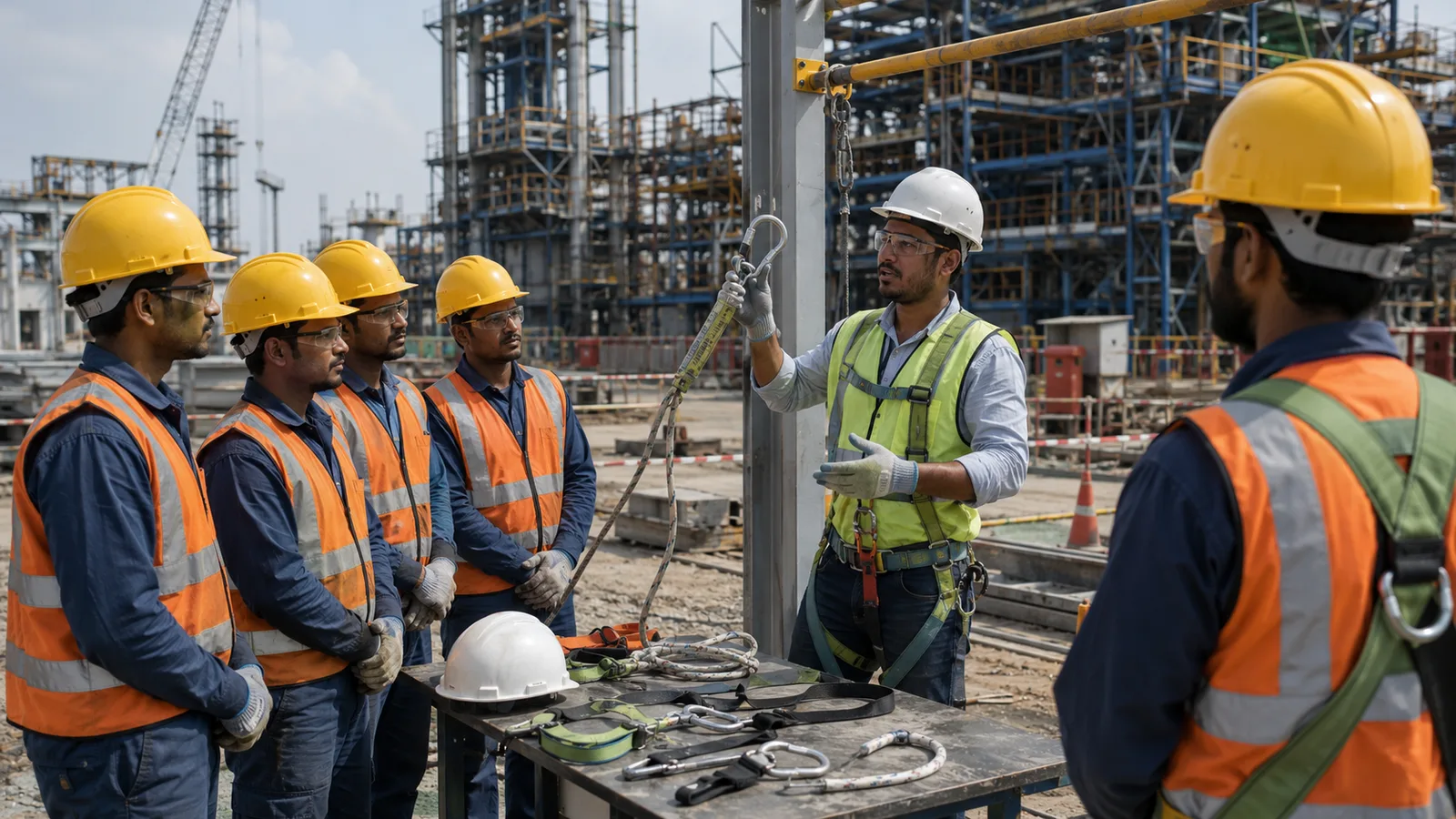
Construction risks change with the task, location, equipment and stage of the project. Safety training therefore has to go beyond induction and continue throughout execution.
A construction project is not one environment but a sequence of very different ones. In the early months, the main risks are excavation, foundation work and heavy equipment. Then come formwork, reinforcement, concreting and work at height on the structure. Later, steel erection, roofing, MEP installation, finishing and commissioning bring new hazards. The workforce also changes, as different trades and subcontractors arrive and leave. A training approach that covers safety only on the first day cannot keep up with this.
Effective safety training is a programme that runs for the life of the project, with different layers for different needs.
Layer one: site induction for common rules
Every person entering the site, whether a worker, engineer, subcontractor, vendor or visitor, should receive an induction before starting work. The induction covers:
- Site rules on PPE, smoking, mobile phones and restricted areas.
- The main hazards on site and how they are controlled.
- Emergency procedures, assembly points and first-aid arrangements.
- How to report hazards, near misses and incidents.
- The worker's right and responsibility to stop unsafe work.
On Indian sites, induction must work for a diverse workforce. Many workers come from other states and speak Hindi, Bengali, Odia or other languages rather than Marathi or English. Some have limited literacy. Induction should be delivered in languages they understand, using pictures, videos and demonstrations rather than only text.
Layer two: toolbox talks for daily risks
Toolbox talks are short safety briefings, typically ten to fifteen minutes, held at the start of the shift. They focus on the day's work: the specific hazards, the controls in place and any changes in conditions.
Good toolbox talks are practical, specific and interactive. A talk about "falls from height" in general is less useful than one about "today we are fixing roof sheets on the east side; here is where the lifeline is, here are the fragile skylight areas, here is how you will move." Workers should be encouraged to ask questions and raise concerns.
Toolbox talks are also the best way to respond to recent events: a near miss on site, a change in weather such as the onset of the monsoon, or a new activity starting.
Layer three: job-specific training for critical activities
High-risk activities need more than a toolbox talk. Workers involved in scaffold erection, rigging and lifting, welding and cutting, excavation, confined space entry, electrical work and roof work need specific training on the hazards, controls, equipment and emergency procedures involved.
This training should be practical, with workers handling equipment and demonstrating competence before they are allowed to perform the task. Competence should be verified, not assumed, even for workers who say they have done the work before.
Layer four: equipment and machine safety
Construction sites use a wide range of equipment: tower cranes, mobile cranes, excavators, hoists, concrete pumps, transit mixers, DG sets, power tools and more. Operators must be competent and, where required, certified. Workers around the equipment must understand the hazards it creates, such as swing radius, blind spots and overhead loads.
Equipment training should cover pre-use checks, safe operation, signalling, exclusion zones and what to do in case of malfunction.
Layer five: fire and emergency drills
Emergencies require rapid, correct responses with little time to think. Regular drills prepare workers and supervisors for fire, injury, structural collapse, electrical accidents and, on industrial sites, process emergencies such as gas leaks.
Drills should test whether people know the alarm, the evacuation route, the assembly point and their roles. They should also test practical skills such as using fire extinguishers and rescuing a worker suspended in a harness. Lessons from each drill should be used to improve the emergency plan.
Training supervisors as safety leaders
Supervisors and foremen have the greatest daily influence on worker behaviour. They need training not only in safety rules but in leading their crews safely: conducting toolbox talks, spotting unsafe acts, intervening respectfully, and making safe decisions under programme pressure. Investing in supervisors multiplies the effect of all other training.
Training subcontractor and short-term workers
One of the hardest training challenges on Indian sites is the constant flow of subcontractor and short-term workers. Specialist crews for waterproofing, false ceilings, painting, glazing or MEP installation may arrive for a few days or weeks and then leave. Labour contractors may rotate workers between sites. It is tempting to skip full training for people who will be on site only briefly.
That is a mistake. Short-term workers are often at higher risk precisely because they are unfamiliar with the site, its hazards and its rules. Every person, however brief their stay, should receive induction before starting work, and specialist crews should be briefed on the specific hazards of their activity on this site. Subcontract agreements should make clear that subcontractors are responsible for ensuring their workers attend training and follow site rules.
Refresher training and learning from events
Safety knowledge fades and habits drift. Refresher training at regular intervals, and whenever there is a significant change in work or conditions, keeps knowledge current. Incidents and near misses, whether on site or elsewhere in the industry, should be turned into learning sessions so the same mistakes are not repeated.
Measuring training effectiveness
Attendance registers show that training happened, not that it worked. Effectiveness is better measured by observing behaviour on site: Are harnesses being used correctly? Are exclusion zones respected? Do workers know what to do in an emergency? Inspection findings and near-miss trends show where training needs strengthening.
Creativve's Approach
At Creativve Constructiions, safety training runs through the full life of every project. Induction sets the foundation, toolbox talks address daily risks, job-specific training prepares workers for critical tasks, equipment training covers machinery, and drills prepare everyone for emergencies. Practical learning in our safety park and focused training for supervisors complete the system. Our aim is for every worker to be prepared not only for their first day on site, but for every changing stage of the work that follows.