
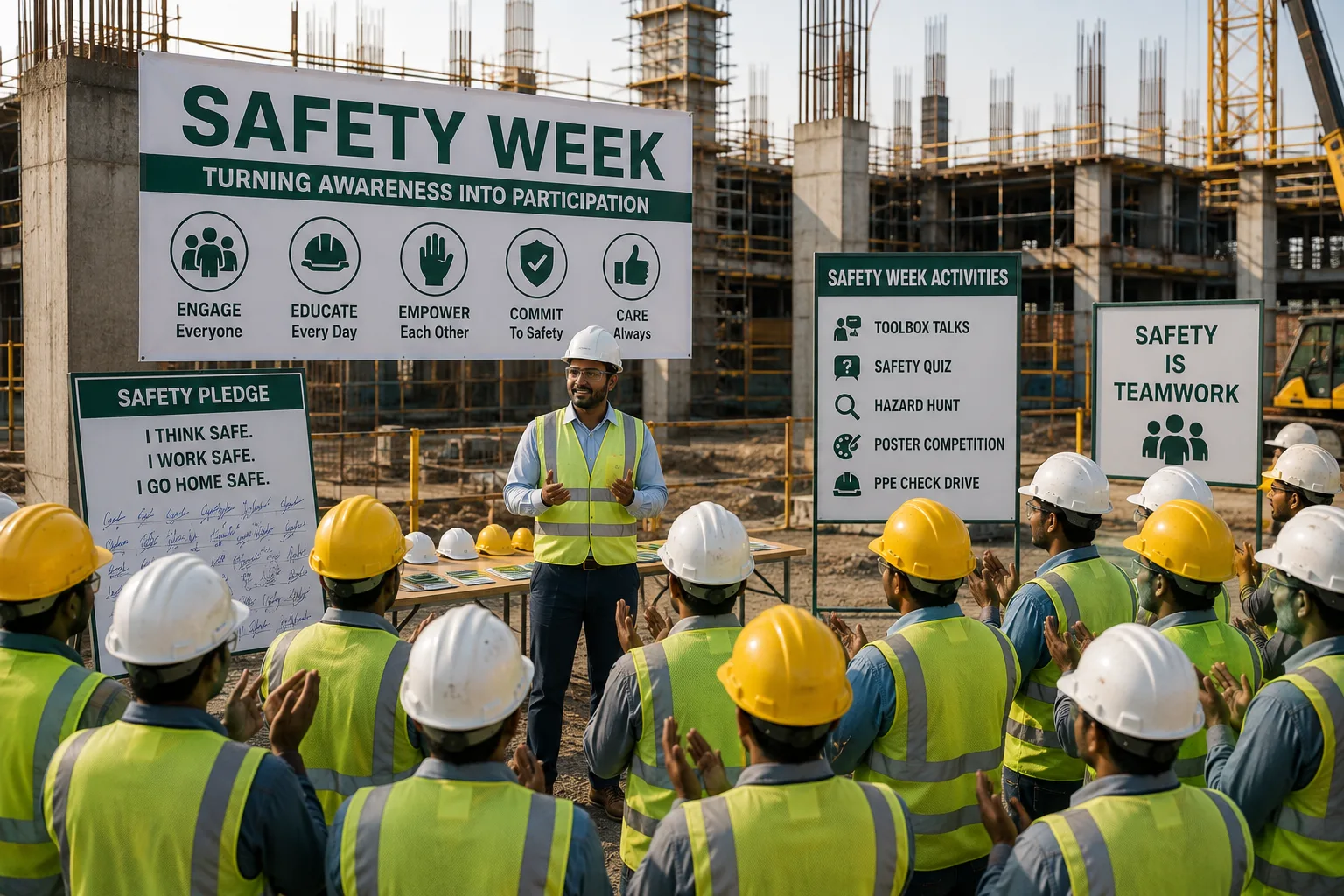
Safety Week is most valuable when it becomes more than posters and speeches. It can create real participation, invite workers to talk about risk and reinforce behaviours that should continue for the rest of the year.
In India, National Safety Day is observed on 4 March, marking the founding of the National Safety Council of India, and many organisations extend it into a National Safety Week. Construction companies, industrial plants and project sites across the country mark the occasion with banners, pledges, speeches and competitions.
At its best, Safety Week energises a site and leaves lasting improvements. At its worst, it becomes a ceremonial event: a pledge read aloud, a banner hung at the gate and a photograph for the newsletter, followed by business as usual. The difference lies in whether the week is designed around participation or around presentation.
Why participation matters
Most safety communication on a construction site flows in one direction: management and safety officers telling workers what to do. Workers listen, sign registers and return to work. This has its place, but it rarely changes behaviour deeply.
Participation is different. When workers take part actively by demonstrating, competing, discussing, suggesting and being recognised, they begin to see safety as something they own. A worker who has explained a hazard to colleagues, or won a prize for spotting unsafe conditions, is far more likely to keep that knowledge alive on site.
Competitions and demonstrations
Well-designed competitions turn learning into engagement. Ideas that work well on construction sites include:
- Hazard-spotting challenges, where teams identify deliberate unsafe conditions in a set-up area.
- Harness-wearing and inspection contests, testing speed and correctness.
- Fire extinguisher operation demonstrations and competitions.
- Safety quizzes in multiple languages, with simple questions about site rules and hazards.
- Poster and slogan competitions, giving workers a creative way to express safety messages.
- First-aid demonstrations and contests among trained first-aiders.
Demonstrations by competent people, such as correct scaffold erection, safe lifting and rigging, rescue from height and electrical safety, show workers what good practice looks like in a way that talks cannot.
Involve workers in identifying risks
Safety Week is a good opportunity to ask workers directly what they see as the biggest risks on site. Small group discussions, suggestion boxes or simple feedback sessions in local languages often bring out issues that supervisors and safety officers have missed: a ladder that is always unstable, an access route that floods during rain, a tool that frequently malfunctions.
Acting visibly on these suggestions shows workers that their views are valued and encourages them to keep speaking up after Safety Week ends.
Recognition of safe behaviour
Recognition is one of the most effective tools for reinforcing good habits. Safety Week can be used to recognise workers, supervisors and subcontractors who have shown consistent safe behaviour: reporting hazards, stopping unsafe work, maintaining good housekeeping or helping colleagues.
Recognition does not need to be expensive. Certificates, small gifts, public acknowledgement in front of colleagues and a photograph on the site notice board can mean a great deal to workers who rarely receive formal appreciation.
Leadership presence
Safety Week is a chance for senior leaders to be visible on site, not only to give speeches but to walk through workfronts, talk with workers, join demonstrations and listen to concerns. When workers see directors and project managers taking safety seriously in person, the message carries more weight than any banner.
Involve the whole site, including subcontractors
Construction sites bring together many organisations: the main contractor, specialist subcontractors, labour contractors, vendors and sometimes the client's own staff. Safety Week activities should involve everyone, not only the main contractor's direct employees. Subcontractor teams can be encouraged to participate in competitions and recognised alongside others.
Make it practical for a working site
A construction site cannot stop for a week. Safety Week activities must fit around production, or they will be squeezed out or resented. Practical approaches include:
- Scheduling short daily activities of thirty to forty-five minutes, usually at the start of the shift or after lunch, rather than long sessions.
- Running competitions crew by crew, so that the whole site is not idle at once.
- Using the safety park or a demonstration area close to the workfront, so time is not lost moving people.
- Planning one larger event, such as a recognition ceremony or a mock emergency drill, on a day when the programme allows.
Content should be chosen for the stage of the project. During structural work, focus on formwork, reinforcement and work at height. During roofing, focus on fragile surfaces, lifelines and lifting. During finishing and MEP, focus on electrical safety, ladders and housekeeping. Linking Safety Week to the risks workers face that month makes it far more relevant than generic messages.
Language matters too. On sites with workers from several states, quizzes, posters and talks should be prepared in Hindi, Marathi and other languages spoken by the workforce, with pictures wherever possible.
Carry lessons back into normal work
The most important part of Safety Week is what happens afterwards. If the energy and attention fade on the eighth day, the week has achieved little. To make it count:
- Turn worker suggestions into action items with owners and dates.
- Continue recognising safe behaviour throughout the year, not just during Safety Week.
- Use competition formats such as hazard spotting and quizzes in regular toolbox talks.
- Review whether the improvements made during the week are being maintained a month later.
Creativve's Approach
At Creativve Constructiions, we see Safety Week as a way to deepen participation, not just to mark an occasion. Our focus is on competitions, demonstrations, worker involvement, recognition and visible leadership presence, followed by action on what workers tell us. Safety culture becomes credible when people can see it in practice, and Safety Week is one of the best opportunities to show it.