
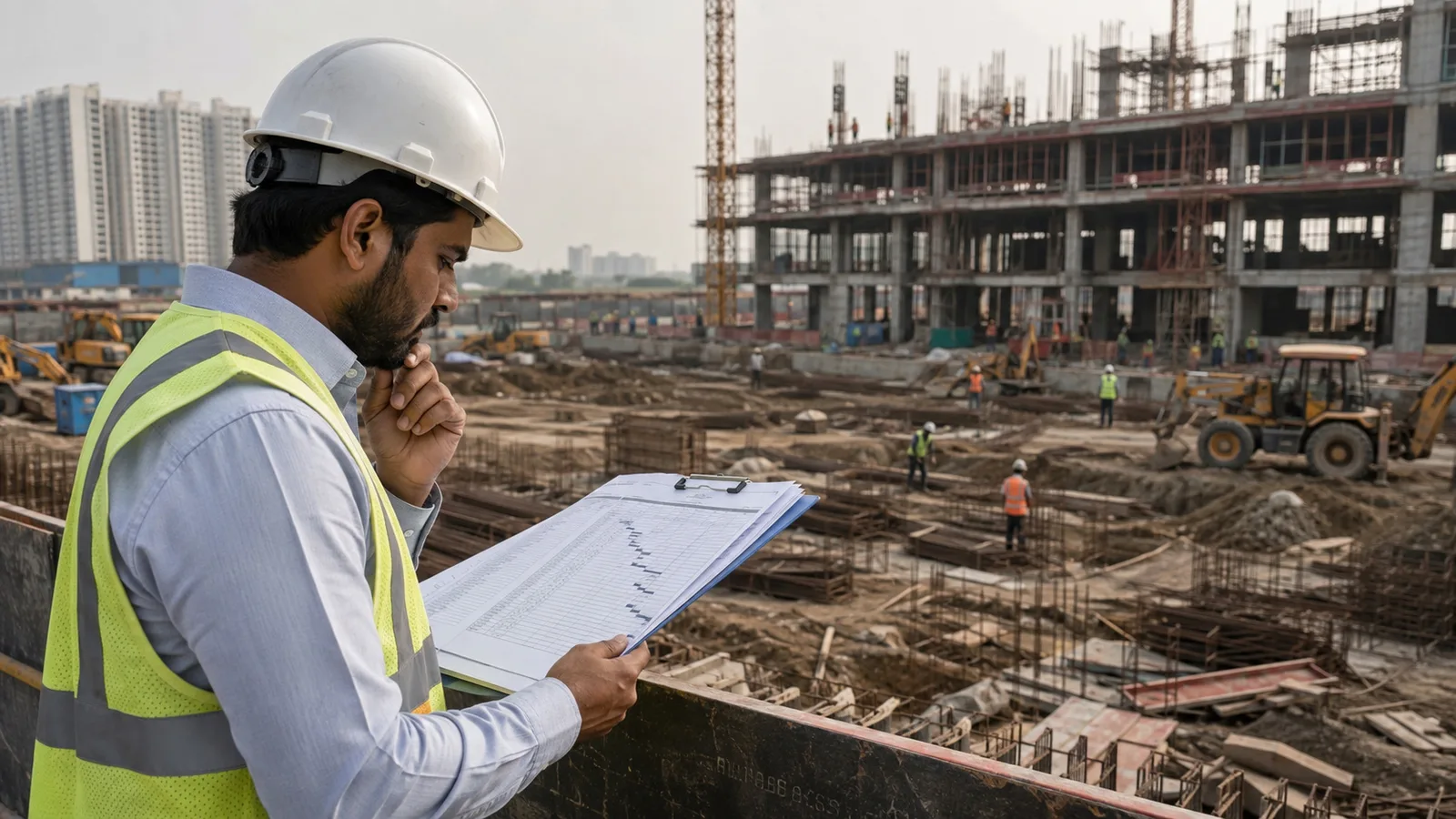
Site delays compound because activities are connected. A drawing held for a day can disturb inspections, subcontractor deployment and follow-on work for much longer.
This is one of the recurring realities of construction management: site performance is often determined by conditions created before the activity starts. The visible event on site is only the last link in a longer chain of planning, information and coordination.
The reality on site
Construction realities are rarely dramatic when they begin. They usually start as a small missing input, a decision that can wait, an area assumed to be ready or a responsibility that has not been made explicit. The cost appears later, when manpower is already committed and the sequence has fewer alternatives.
What good teams do differently
The practical controls are simple, but they require consistency:
- Close decisions quickly. This requires clarity about who owns the outcome and what decisions can be taken at each level. Strong leaders do not simply escalate every difficulty. They assemble the facts, act within their authority, communicate the consequence and make sure the issue is carried through to closure.
- Protect dependency chains. Sequence converts individual activities into a project. Dependencies, access, approvals and resource movement need to be understood before short-term pressure forces teams into out-of-sequence work. A useful programme therefore remains connected to look-ahead planning and daily site decisions.
- Use look-ahead planning. Sequence converts individual activities into a project. Dependencies, access, approvals and resource movement need to be understood before short-term pressure forces teams into out-of-sequence work. A useful programme therefore remains connected to look-ahead planning and daily site decisions.
- Escalate constraints before they become delays. The important part is to convert this principle into an observable site control with a clear owner, a defined time for action and a way to confirm closure. Construction becomes more predictable when important expectations are made explicit rather than left to individual interpretation.
Why it matters
The management lesson is to follow the cause upstream. Waiting, congestion, rework and lost productivity are often symptoms of an earlier planning or coordination gap. Fixing only the visible symptom can make the site busy without making the project healthier.
Creativve's Approach
At Creativve Constructiions, we treat this reality as an execution principle. The objective is to remove avoidable uncertainty before it reaches the workfront and to keep planning connected to what teams can actually build.