
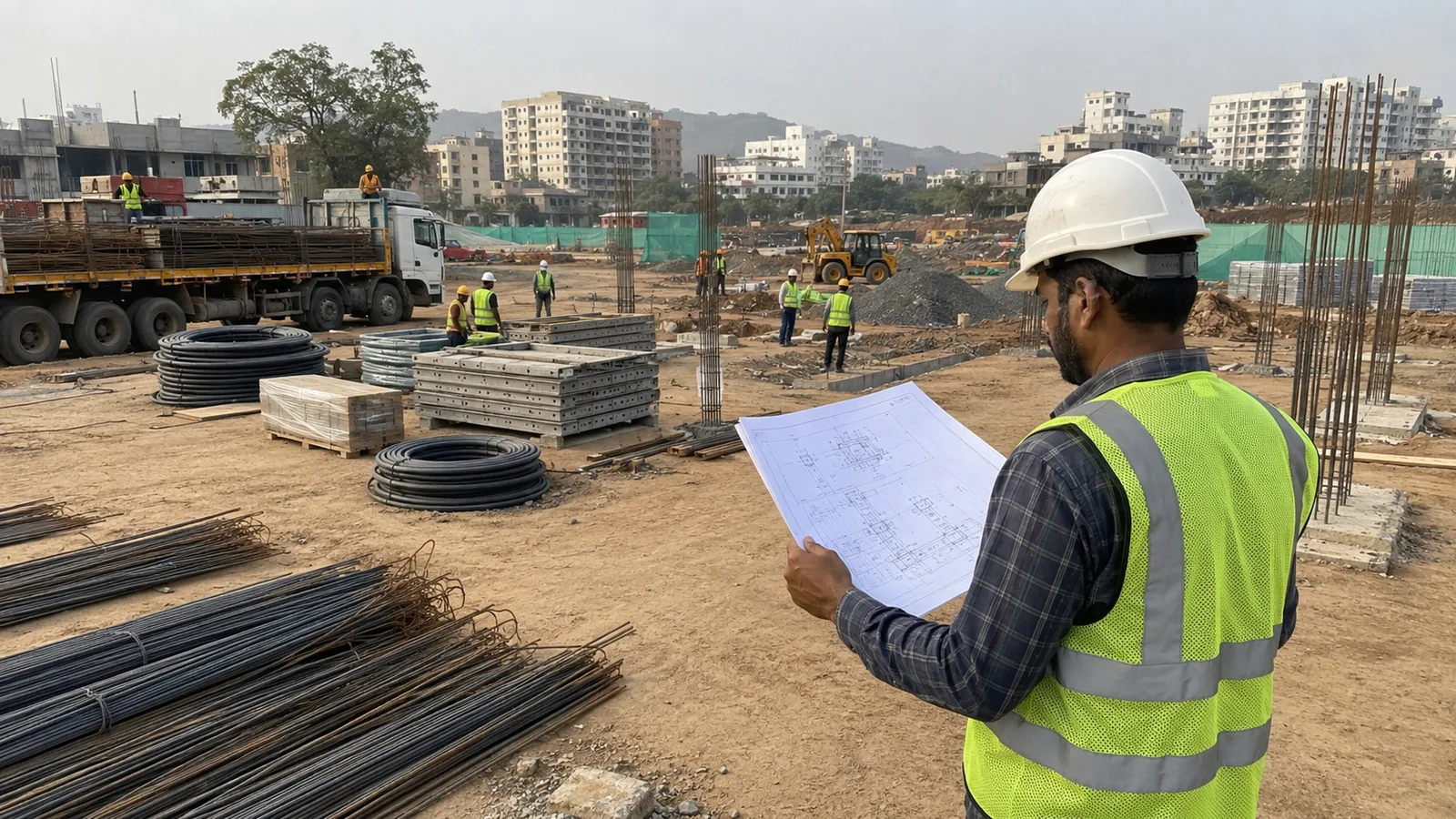
Mobilising early is useful only when the project can turn that mobilisation into productive work. Clarity on scope, drawings, access and interfaces should lead the mobilisation plan, not follow it.
There is a familiar pattern at the start of many Indian construction projects. The work order is signed, the client wants to see activity, and the contractor rushes to set up site offices, labour camps, stores and batching arrangements. Within days, labour arrives and machinery is unloaded. On paper, the project has started. In reality, nobody yet knows exactly what the first few weeks of work should be, because the scope boundaries are unclear, the "good for construction" drawings are pending and the site is not fully available.
The result is an expensive pause disguised as a start.
The reality on site
Construction realities are rarely dramatic at the beginning. They usually start as small gaps: a scope item that both client and contractor assume belongs to the other, a drawing that is "almost final", a portion of land still occupied by an old structure, or a utility line that nobody has located. Each gap seems minor when the project is signed. Each becomes a constraint once labour and equipment are waiting.
Because the costs of mobilisation are front-loaded, with camp construction, site establishment, equipment transport and initial wages, a slow start damages the project's finances and morale early, before any real progress has been made.
Clarify package boundaries
On projects with multiple contractors, the boundaries between packages are a frequent source of confusion. Who builds the equipment foundations: the civil contractor or the equipment vendor? Who provides cable trenches: civil or electrical? Who is responsible for the site drainage connecting to the municipal or MIDC network? Who supplies temporary power and water?
If these questions are not answered before mobilisation, they surface on site as disputes and delays. A clear scope matrix, listing each item and the responsible party, should be agreed at the start. It does not need to be complicated, but it must be specific.
Confirm what can actually be built first
Before bringing large teams to site, the project should identify the first executable workfronts: areas where drawings are approved, the land is available, access is clear and materials can be supplied. Typical early workfronts include site clearance, survey, temporary works, boundary walls, excavation in areas with approved foundation drawings and approach roads.
If only a few workfronts are ready, mobilisation should be sized for those, with additional resources planned to arrive as more areas open. There is no value in bringing two hundred workers to a site where only fifty can work productively.
Mobilise in planned stages
Staged mobilisation matches resources to genuine demand. A typical sequence might be:
- Initial establishment: site office, stores, security, basic facilities and survey team.
- Early works: excavation and foundation crews for the first released areas.
- Ramp-up: structural, masonry and services teams as drawings and areas become available.
- Peak: full resources once multiple workfronts are open simultaneously.
This approach reduces idle costs and gives the planning team time to prepare each stage properly. It also avoids overcrowding the site with workers and equipment that get in each other's way.
Avoid site congestion and idle labour
An overcrowded site is not a productive one. Too many workers in too few workfronts leads to congestion, poor supervision, safety risks and wasted effort. Workers waiting for work are also more likely to leave for other projects, especially in active construction markets like Pune, where demand for skilled labour is high.
Resource strength should be measured by productive output, not headcount. A smaller team working continuously on ready workfronts will usually achieve more than a larger team that keeps waiting.
Plan the labour camp and logistics properly
Mobilisation also involves basic logistics that are easy to underestimate. Labour accommodation must meet welfare requirements for water, sanitation and safety. Material storage areas need to be planned so they do not block future work. Temporary power, water supply and site roads need to be ready before heavy resources arrive. On remote industrial sites, arrangements for food, transport and medical support may also be required.
These arrangements take time and money, and they should be planned as carefully as the construction itself.
Questions to answer before mobilising
A short set of questions, answered honestly before resources are committed, prevents most mobilisation problems:
- Is the site handed over, with boundaries, benchmarks and access confirmed?
- Which drawings are approved for construction, and which are still pending?
- What can genuinely be built in the first four weeks, and where?
- Are scope boundaries with other contractors and vendors agreed in writing?
- Are temporary power, water and approach roads available, or must they be created first?
- Have existing underground services been identified on brownfield sites?
- Are statutory permissions within the client's or contractor's scope in place?
- Is the monsoon due within the first few months, and how will it affect the early sequence?
If several of these answers are uncertain, a smaller initial mobilisation, focused on site establishment, survey and enabling works, is the wiser choice. Resources can then be ramped up quickly once the uncertainties are resolved, without paying for weeks of idle labour and equipment.
Why it matters
The management lesson is to follow the cause upstream. Idle labour, congestion and slow early progress are often symptoms of a mobilisation that ran ahead of planning. Fixing only the visible symptom, for example by pushing for more output, keeps the site busy without making the project healthier.
Creativve's Approach
At Creativve Constructiions, we treat mobilisation as a planned activity, not a show of strength. Before bringing resources to site, our teams work with the client to clarify scope boundaries, confirm available workfronts and sequence mobilisation in stages that match real demand. Our objective is to remove avoidable uncertainty before it reaches the workfront, so that the first weeks of a project build momentum rather than cost.