
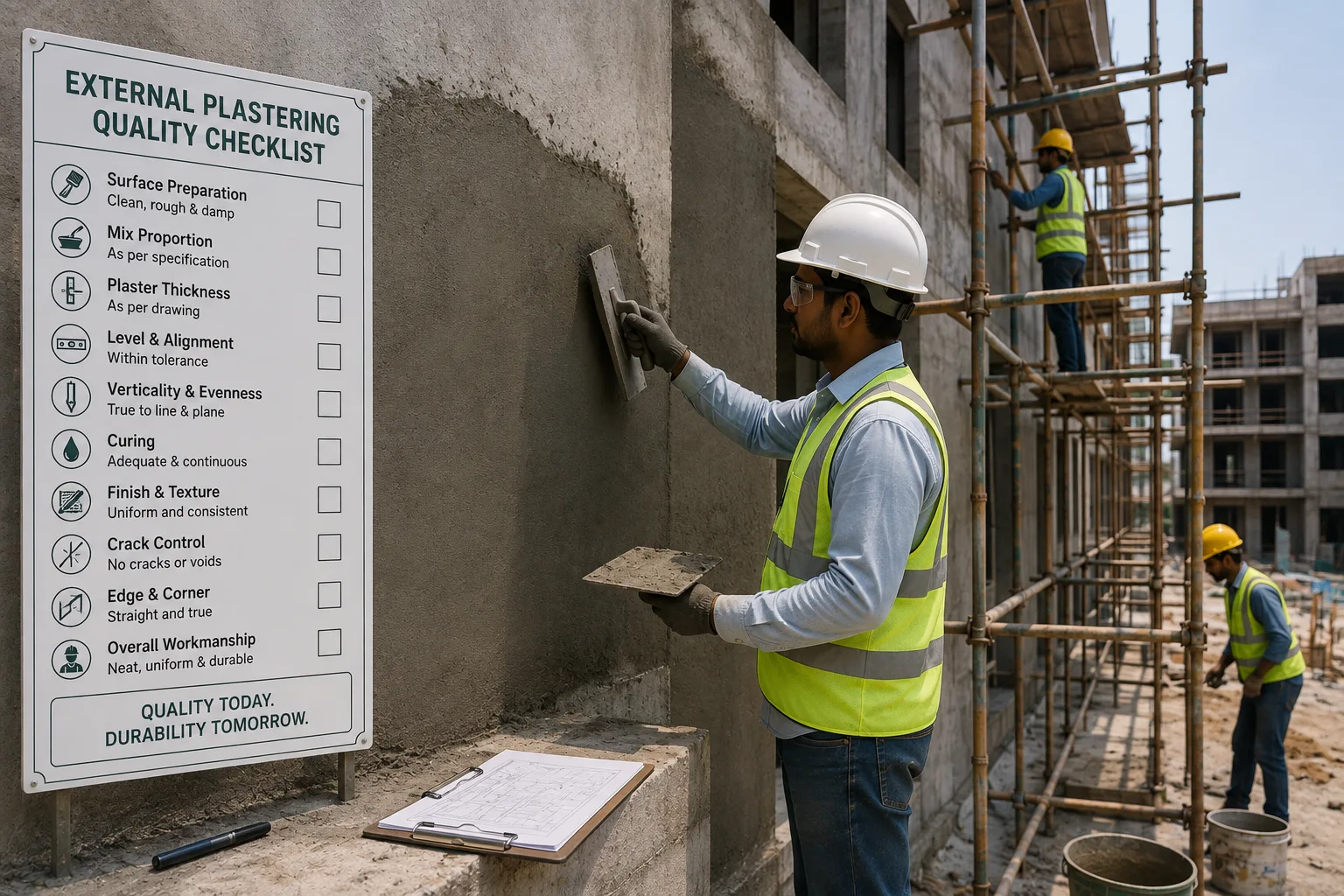
External plaster is exposed continuously to weather and movement, which makes substrate preparation, bonding, thickness, curing and crack-control details especially important.
The purpose of this guide is practical: to identify the controls that make execution more predictable and reduce avoidable defects. Project specifications and approved drawings always remain the governing requirements.
What to control
A practical quality review should cover the controls below. The approved project specification, drawings, method statement and inspection plan remain the governing requirements, while this article provides a field-oriented framework for preparation and review.
- Prepare and clean the substrate. The important part is to convert this principle into an observable site control with a clear owner, a defined time for action and a way to confirm closure. Construction becomes more predictable when important expectations are made explicit rather than left to individual interpretation.
- Repair honeycombs and uneven interfaces. Interfaces are where otherwise correct packages can conflict. Coordination should identify levels, openings, loads, embedded items, service routes and responsibility boundaries before work is fixed in place. An interface register or coordinated review is valuable only when decisions are tracked through to execution.
- Fix chicken mesh or reinforcement where specified. The important part is to convert this principle into an observable site control with a clear owner, a defined time for action and a way to confirm closure. Construction becomes more predictable when important expectations are made explicit rather than left to individual interpretation.
- Establish level dots and thickness control. The important part is to convert this principle into an observable site control with a clear owner, a defined time for action and a way to confirm closure. Construction becomes more predictable when important expectations are made explicit rather than left to individual interpretation.
- Maintain mix consistency and curing. Quality needs to be verified at the stages where correction is still simple. Approved materials, first-off checks, hold points and evidence of inspection reduce the chance that a hidden or repeated defect will move downstream. The aim is prevention and consistency, not a larger snag list at the end.
- Inspect grooves, edges, junctions and final surface. The important part is to convert this principle into an observable site control with a clear owner, a defined time for action and a way to confirm closure. Construction becomes more predictable when important expectations are made explicit rather than left to individual interpretation.
Before closing the activity
The final check should confirm not only appearance, but also interfaces that will become difficult to inspect after the next trade starts. Photographs, inspection records and measured checks create useful evidence for handover and help teams identify recurring workmanship issues early.
Creativve's Approach
At Creativve Constructiions, technical checklists are practical control tools. They help teams prepare the workfront, inspect critical stages and maintain consistent standards across repeated work. The intention is to prevent defects while correction is still simple, rather than depend on end-stage snagging.