
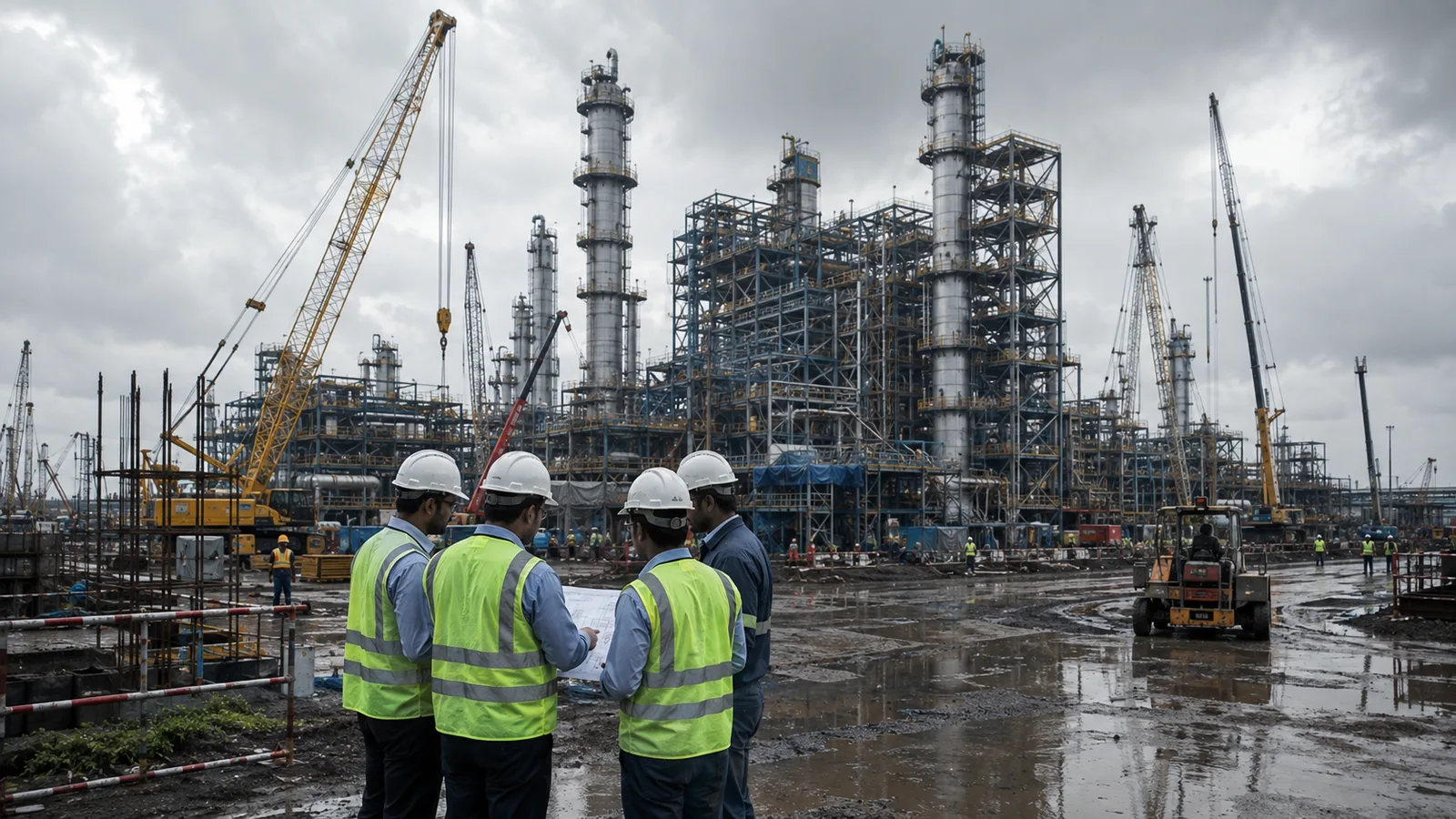
Industrial projects are remembered not only for what was built, but for the constraints overcome while building it. Creativve Constructiions' work at DOW, Lote MIDC combined major multidisciplinary execution, large resource deployment and a programme that had to absorb the realities of a Konkan monsoon.
Lote Parshuram MIDC lies near Khed in Ratnagiri district, in the Konkan region of Maharashtra. It is an established chemical industrial area, set in hilly terrain between the Sahyadri ranges and the coast. It is also one of the wettest parts of the state, with heavy monsoon rainfall that can disrupt construction for weeks at a time. For a construction team, it is a location that rewards careful planning and punishes improvisation.
The scope of work
The project for Dow Chemicals International Pvt. Ltd. was delivered on a design and build basis and covered approximately 2,50,000 sq.ft. It was one of the most detailed and multidisciplinary projects Creativve Constructiions has executed, spanning RCC structures, PEB buildings, MEP systems, interiors and complete site infrastructure.
The key components included:
- An office building with a G+1 RCC structure, ACP facade and glazing.
- Internal MEP systems, external infrastructure and landscaping.
- Warehouse and plant facilities combining civil works and PEB structures for raw material and finished goods storage.
- RCC utility buildings.
- Internal and external roads in WBM, bituminous and concrete construction.
- Stormwater gutters, paving blocks, kerb stones and box culverts.
- Interior and architectural works including false ceilings, furniture, glass partitions and acoustic panels.
- 3M glass and projector films, along with facade enhancement.
- Epoxy flooring across 1,21,000 sq.ft.
- Roadside horticulture and tree plantation.
The project by the numbers
A few figures give a sense of the scale involved:
- Around 50,000 bags of cement consumed across the works.
- A workforce that reached around 250 people.
- Execution over roughly 16 months.
- About four months of monsoon conditions within the programme.
- Project commissioning in 2017.
Planning around the Konkan monsoon
With roughly a quarter of the programme falling in the monsoon, weather was a central planning factor rather than an occasional disruption. Heavy rain in the Konkan affects nearly every activity: excavation and foundations, concreting, earthwork for roads, external finishes and material deliveries along ghat roads.
Projects in such conditions depend on sequencing work so that weather-sensitive activities are completed before the rains, and getting buildings under roof early so that internal work can continue through the monsoon. Material storage needs protection from water, drainage on site must be functional early to prevent waterlogging, and the daily plan has to adapt to the weather actually experienced rather than the weather assumed in the programme.
Over a 16-month execution period with this much monsoon exposure, maintaining progress meant constantly translating the master programme into short-horizon decisions about what could realistically be done each week.
Managing scale and resources
A workforce of around 250 people and the material movement implied by some 50,000 cement bags place real pressure on site logistics. Labour accommodation, welfare facilities, material storage, internal access routes and supervision all had to be planned for that scale.
For a site in a relatively remote MIDC area, these arrangements matter even more. Labour and materials must be mobilised from a distance, local suppliers may be limited, and medical facilities are farther away. Planning resources in stages, keeping workfronts ready and maintaining supervision strength across multiple simultaneous activities were essential to keeping such a large team productive.
Coordination across disciplines
The range of the scope, from RCC office and utility buildings to PEB warehouses, MEP systems, interiors, roads, drainage and landscaping, meant that many trades and packages had to work together on the same site. Interfaces between civil, structural steel, MEP and interior works had to be coordinated carefully so that services were embedded in time, finishes were not damaged by later trades and handover areas were completed in a logical order.
Infrastructure and finishing at the same scale
It is easy to focus on the main buildings in a project like this, but the infrastructure and finishing scope was equally demanding. Internal and external roads in three different specifications, WBM, bituminous and concrete, each need their own sub-base preparation, compaction, drainage falls and curing or rolling. Stormwater gutters and box culverts must be sized and built to carry Konkan monsoon runoff without flooding the site. Paving blocks and kerbs require accurate levels to drain properly.
At the other end of the scale, the interior works in the office building, including false ceilings, glass partitions, acoustic panels, furniture and specialised films, demand fine finishing and careful protection from damage by other trades. Epoxy flooring across 1,21,000 sq.ft. needs a properly prepared, dry substrate and controlled application conditions, which is a real challenge in a region where humidity stays high for much of the year.
Delivering heavy infrastructure and fine interior finishes within the same programme required planning both the sequence and the protection of completed work.
Industrial safety at scale
Working on a facility for a global chemical company brings high safety expectations. With a large workforce and many simultaneous activities, including work at height, PEB erection, heavy lifting, road works and interiors, safety had to be integrated into planning and supervision every day.
The project's safety performance became one of its most notable outcomes. The site achieved one million safe man-hours, a milestone recognised by DOW's senior team in India and covered in a separate story.
What the project demonstrated
The DOW, Lote MIDC project showed the value of disciplined industrial execution under changing site conditions. Large quantities and a large workforce create capability only when they are supported by workfront planning, supervision, safety controls and dependable coordination. Commissioning in 2017 marked the completion of the physical scope, while the learning from the project has continued to shape how Creativve Constructiions plans and executes large industrial work.
Creativve's Approach
For Creativve Constructiions, the lessons from DOW, Lote MIDC reach well beyond one site: plan around the monsoon instead of against it, mobilise resources in step with ready workfronts, coordinate multidisciplinary interfaces early and integrate safety into every day's work. These practices are carried forward into the industrial projects that have followed.