
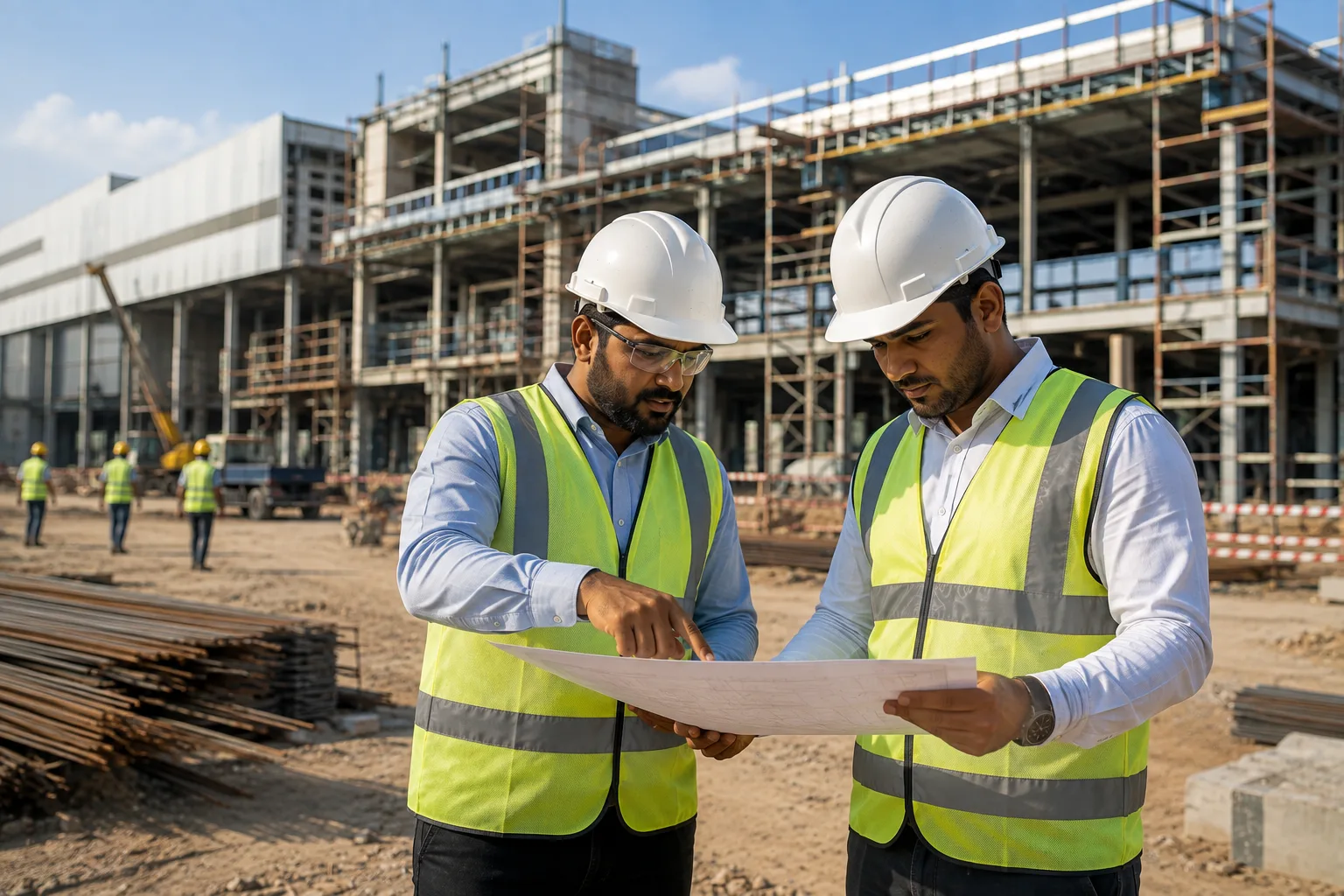
Industrial projects need managers who can connect planning with site reality. The work demands coordination, discipline, responsibility and a consistent approach to quality and safety, and the contribution of Project Manager Rajendra Aher at Cipla, Verna shows what that looks like in practice.
Construction companies are often described through their projects: the clients they serve, the square footage they build and the industries they work in. Behind every one of those projects is a team, and within that team are individuals whose consistency, judgement and sense of ownership make the difference between a project that struggles and one that runs well. This story is about one such contribution.
The setting: pharmaceutical construction in Goa
Verna, in South Goa, is one of the state's major industrial estates and home to a number of pharmaceutical manufacturing facilities. Pharmaceutical projects are among the more demanding types of industrial construction. Facilities must meet strict standards for cleanliness, finishes, services and documentation, because they ultimately support regulated manufacturing.
Projects of this kind also bring the challenges common to construction in Goa. The monsoon is long and heavy, typically running from June to September, and it affects excavation, concreting, roofing and external works. Logistics and labour planning need particular attention, because skilled manpower and some materials often have to be mobilised from other regions.
In this environment, the project manager's role goes well beyond supervising activities. It involves keeping planning, procurement, labour, quality, safety and client coordination aligned day after day.
What ownership looks like on site
Rajendra Aher's contribution at Cipla, Verna has been recognised within Creativve Constructiions for ownership of site activities, coordination and responsible execution. Ownership is a word that is used often, but on a construction site it has a practical meaning:
- Treating site problems as one's own responsibility to solve, rather than waiting for someone else to step in.
- Following up on pending drawings, materials and approvals until they reach the site.
- Checking work personally at critical stages rather than relying only on reports.
- Taking responsibility for both what went well and what needs correction.
- Keeping the client informed accurately, including when the news is not good.
These behaviours are not dramatic, but they are what keep a project moving.
Coordination and leadership
Industrial projects involve many parties: the client's project and engineering teams, consultants, specialist vendors, subcontractors and the contractor's own staff. Each has its own priorities and timelines. The project manager sits at the centre, making sure decisions are taken in time, information flows correctly and work happens in the right sequence.
Good coordination is often invisible when it works. Materials arrive when needed, inspections happen on schedule and trades follow one another without conflict. The value becomes obvious only when coordination fails. Strong project leadership prevents those failures through daily attention to detail.
Team discipline
Discipline on a construction site shows up in small, repeated actions: starting on time, maintaining housekeeping, following permit procedures, completing inspection records and closing observations. A project manager sets the tone for this discipline. When the leader is consistent, the team follows. When standards slip at the top, they slip everywhere.
In a pharmaceutical environment, where cleanliness, documentation and procedural compliance matter greatly, team discipline is especially important. Work that is technically correct but poorly documented, or completed without following agreed procedures, can create real problems for the client.
Responsible execution
Responsible execution means delivering work safely, to the required quality and in a way that the client can rely on. It means not cutting corners when the programme is under pressure, not hiding problems and not passing difficulties on to the next stage. It is the combination of technical competence and personal integrity.
The daily rhythm of project leadership
Much of a project manager's contribution is invisible in a final photograph of the finished building. It lies in the daily rhythm of the site: the morning walk-through to check progress and conditions, the coordination meeting where priorities are set, the follow-up calls to suppliers and consultants, the inspection before a pour, the evening review of what was achieved and what is needed tomorrow.
On an industrial project for a demanding client, this rhythm has to be sustained for months without slipping. It means noticing the small things early: a delivery that may arrive late, a drawing query that has not been answered, a crew that is short of strength, a safety condition that is starting to drift. Each of these, caught early, is a small adjustment. Each, missed, becomes a problem for the whole team.
That steady attention is what the organisation recognised in Rajendra Aher's work.
People recognition as part of project culture
Creativve Constructiions recognises individual contributions through its employee appreciation programme. Recognition serves two purposes. It acknowledges the person whose work has made a difference, and it shows the wider organisation, particularly younger engineers, what the company values in practice.
Rajendra Aher's work has been recognised for discipline, loyalty, honesty, leadership and ownership. These are not abstract qualities. They are visible in how a project is managed every day, and they are qualities we want every site leader to develop.
Why people stories belong in a project company
Construction is judged through projects, but projects are delivered by people. Highlighting individual contributions connects organisational values with real work. It shows that leadership is not limited to senior management and that the people managing sites every day are central to the company's reputation.
For younger engineers, these stories offer practical examples of what good project leadership looks like. They show that career growth in construction is built on reliability, responsibility and steady learning on site.
Creativve's Approach
At Creativve Constructiions, we carry project learning forward, and much of that learning lives in our people. The ownership, coordination and discipline demonstrated on projects like Cipla, Verna are carried by individuals from one assignment to the next and shared with the teams around them. Recognising these contributions helps make our values tangible, and helps us build a stronger organisation for the projects ahead.