
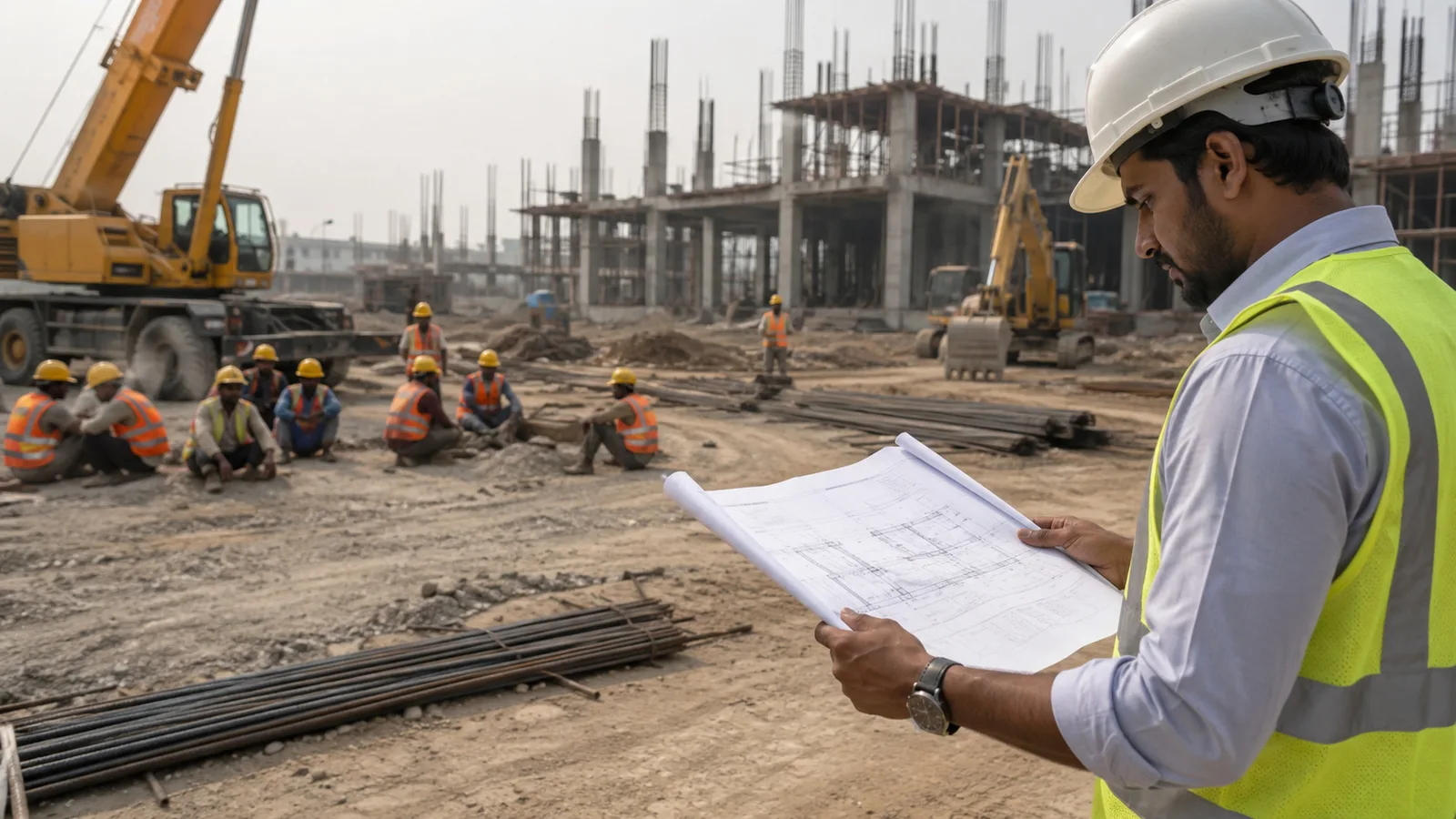
Idle manpower is easy to see. The planning failure that created it is usually much less visible.
Every site manager knows the sight: a gang of workers sitting in the shade at eleven in the morning, tools beside them, while the programme says they should be halfway through their task. The natural reaction is frustration with the subcontractor. Why are your people not working? The subcontractor's answer is usually some version of "we cannot work because..." and that answer deserves more attention than it usually gets.
Follow the constraint upstream
Good construction management treats idle labour as a symptom and looks for the cause. A useful method is to keep asking "why" until the real cause appears. Consider an example:
- Why is the plastering gang idle? Because the masonry in their area is not complete.
- Why is the masonry not complete? Because the masons were waiting for blocks for two days last week.
- Why were the blocks late? Because the purchase order was placed late.
- Why was the order placed late? Because the quantity was not confirmed until the revised architectural drawing was issued.
- Why was the drawing revised late? Because a client decision on the room layout was pending for three weeks and was not tracked as a constraint.
The idle plastering gang today is the result of an untracked client decision a month ago. Shouting at the plasterers will not fix it. Tracking pending decisions as constraints will.
Common upstream causes
When idle time is traced back, the causes tend to fall into a few familiar categories:
- Information: drawings not issued, revisions not communicated, details unclear or missing.
- Materials: late orders, delayed deliveries, wrong specifications or insufficient quantities.
- Predecessors: the previous activity incomplete, not inspected or done incorrectly.
- Access: area occupied by another trade, blocked by materials or unsafe to enter.
- Approvals and permits: inspections not done, permits not issued, client sign-offs pending.
- Equipment: crane, hoist, pump or scaffolding unavailable or broken down.
- Decisions: client, consultant or management decisions pending.
Most of these are planning and coordination issues, not workforce issues.
Record lost hours and their causes
What is not recorded cannot be managed. Daily site reports should note idle hours for each crew, with the specific cause. Over weeks, this record reveals patterns. If most idle time is caused by late drawings, the drawing process needs attention. If it is caused by material delays, procurement needs to change. If it is caused by incomplete predecessors, sequencing and supervision need review.
Without records, idle time is discussed in general terms and blamed on whoever is most visible. With records, it can be traced and fixed.
Separate genuine productivity problems
Not all idle time is a planning problem. Sometimes a subcontractor deploys too few supervisors, workers lack the skills needed, or crews simply do not work efficiently. These are real productivity issues and should be addressed directly with the subcontractor.
Recording the causes of idle time helps separate the two. When the workfront was genuinely ready and the crew still underperformed, the issue lies with the crew. When the workfront was not ready, the issue lies upstream. Fair assessment makes it possible to hold subcontractors accountable for what they control, without blaming them for what they do not.
The commercial side of idle time
Idle time has commercial consequences. Subcontractors working on labour-rate or item-rate contracts may claim compensation for idle time caused by others. Clear records of causes support fair settlement of these claims, protect the main contractor's position with the client where the client caused the delay, and prevent disputes based on memory and assumption.
Seasonal and labour-market patterns
Some idle time follows predictable patterns in India, and planning should anticipate them. Around Diwali, Holi and Chhath, and during sowing and harvest seasons, many migrant workers travel home to states such as Bihar, Uttar Pradesh, Jharkhand, Odisha and West Bengal. Crews can shrink suddenly, leaving partly completed workfronts and causing idle time for the trades that depend on them.
The monsoon creates a different pattern. Outdoor activities stop on heavy rain days, and crews assigned only to external work are left with nothing productive to do unless indoor workfronts have been prepared.
Neither of these is a surprise. A planning team that knows the calendar can schedule critical activities away from festival periods, agree manpower retention arrangements with labour contractors, and keep indoor work ready for wet days. Idle time that recurs every year at the same season is a planning gap, not bad luck.
Prevention through readiness
The best way to reduce idle time is to check workfront readiness before deploying crews, keep a constraint log with owners and dates, maintain a look-ahead plan reviewed weekly, and keep alternative workfronts available for redeployment. These practices shift attention from reacting to idle time to preventing it.
Why it matters
The management lesson is to follow the cause upstream. Idle labour is visible, but its causes are often weeks old and buried in drawings, decisions and orders. Fixing only the visible symptom keeps the site busy without making the project healthier.
Creativve's Approach
At Creativve Constructiions, we treat idle time as a diagnostic signal. Our site teams record lost hours and their causes, trace them back to their origin and use what they find to improve planning, procurement and coordination. We hold subcontractors accountable for what they control, and we hold ourselves accountable for creating the conditions in which they can work. Our objective is to remove avoidable uncertainty before it reaches the workfront.