
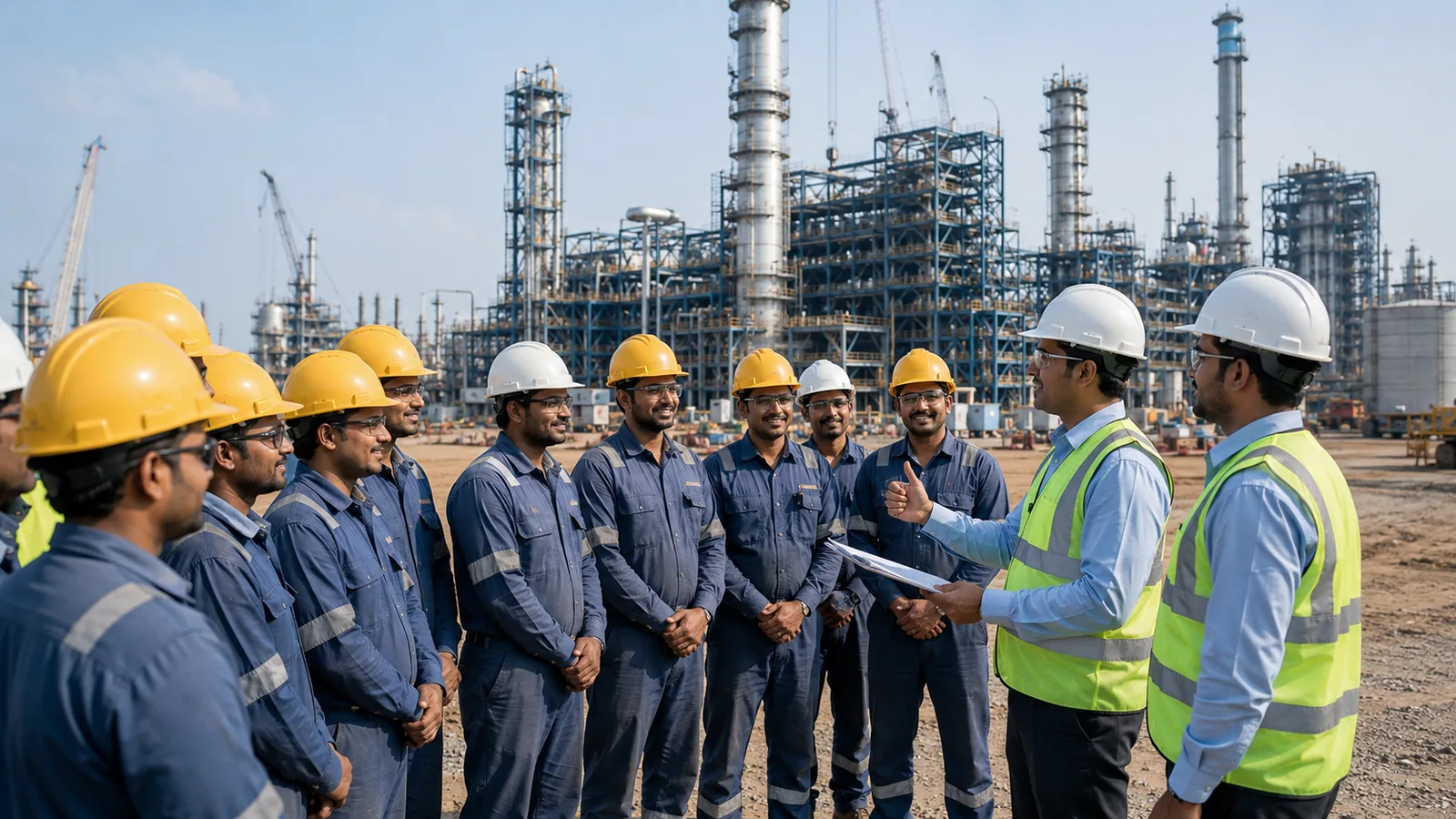
Achieving one million construction man-hours without a safety incident is not the result of one campaign or one inspection. It is the cumulative outcome of thousands of routine decisions made correctly across planning, supervision, training and workforce participation.
Safety milestones are sometimes celebrated with banners and ceremonies, and they deserve to be. But the real story of a milestone like one million safe man-hours is not the celebration. It is the long, unglamorous sequence of everyday actions that made it possible. Understanding those actions is what allows an organisation to repeat the achievement on the next project.
The arithmetic of a million hours
Consider a site with 250 workers on eight-hour shifts, six days a week. That site accumulates around 12,000 man-hours a week and roughly 50,000 a month. Reaching one million man-hours takes well over a year and a half at that pace.
Over that time, the site may see thousands of lifts, hundreds of concrete pours, months of work at height, monsoon weather, workforce turnover, new subcontractors and changing activities. Every one of those hours carries risk. A single serious lapse at any point breaks the record. That is why such milestones are difficult, and why they say a great deal about how a site is managed.
Milestones matter when they reflect a repeatable system
A safety record can sometimes be the result of luck as much as management. A site with poor practices may go a long time without a serious incident, simply because the dangerous situation never quite turned into an accident. That kind of record is fragile.
A milestone has real value only when it reflects a system that can be repeated: one where risks are controlled deliberately, near misses are reported and learned from, and standards are maintained consistently. When that system exists, the milestone is evidence of it. When it does not, the milestone is just a number waiting to be broken.
Induction and job-specific training
Every one of those million hours begins with a worker who knows what is expected. Induction introduces each new worker to the site's rules, hazards, emergency procedures and reporting systems. On Indian sites with workers from many states and language backgrounds, induction must be practical, visual and delivered in languages people understand.
Job-specific training builds on induction for high-risk tasks. Workers doing height work, rigging, welding, excavation or electrical work need training on the specific hazards and controls involved, and supervisors must confirm that they understand before work begins.
Risk assessment and permit discipline
High-risk activities need deliberate control. Risk assessments identify hazards and controls before the work starts. Permits confirm that those controls are in place on the day. When this discipline is maintained throughout a long project, most serious incidents are prevented before conditions for them ever arise.
The challenge is consistency. Over many months, the temptation grows to treat permits as formalities. Maintaining their value requires supervisors who inspect before signing and managers who check that the system is working.
Active supervision and intervention
Supervisors are the people most likely to see unsafe acts and conditions as they happen. A culture that supports a million safe hours is one where supervisors intervene immediately: stopping a worker without a harness, correcting an unsafe stack of materials, closing an open edge.
Intervention must be respectful and consistent. Workers accept correction more readily when it is applied fairly to everyone and explained clearly.
Worker participation and reporting
No safety team can watch every activity. The workforce itself must be part of the system. Workers who report hazards, warn colleagues, use stop-work authority and participate in toolbox talks multiply the site's safety capacity many times over.
Participation grows when workers see that their input matters. When a reported hazard is fixed quickly, when a worker who stopped unsafe work is thanked, when suggestions are taken seriously, participation increases. When reports are ignored or punished, it disappears.
Leadership attention that does not fade
Over a long project, leadership attention tends to drift towards progress, cost and client demands. Safety performance that has been good for months can begin to feel secure, and attention moves elsewhere. That is exactly when standards begin to slip.
Leaders who sustain a million safe hours keep safety in every meeting, walk the site regularly, recognise good practice and respond quickly to warning signs.
Learning from near misses
Near misses are the most valuable data a site has. Each one is a warning that a control failed, even though no one was hurt. Sites that achieve long safety records usually report many near misses, not few, because they have created a culture where people are comfortable sharing them. Investigating and acting on near misses prevents the incidents that would otherwise follow.
Subcontractors inside the culture
On Indian sites, most of those million hours are worked by people employed through subcontractors and labour contractors. A safety culture that reaches only the main contractor's own staff cannot produce a milestone like this. Subcontractor supervisors must be part of toolbox talks, inspections and incident reviews. Subcontract terms must make safety expectations clear. Subcontractors who perform well should be recognised, and those who repeatedly fall short should face consequences. When every organisation on site is held to the same standard, the culture becomes site-wide.
Experience captured and reused
Projects and people are shaped by the way planning, coordination, communication, safety and ownership come together over time. The value of a safety milestone grows when the lessons behind it are captured and carried forward to other projects, rather than remaining with the team that achieved it.
Creativve's Approach
Creativve Constructiions has achieved one million safe man-hours on a major industrial project, and we see that milestone as evidence of a system rather than an isolated success. Induction, job-specific training, risk assessment, permit discipline, active supervision, worker participation and steady leadership attention are what make such records possible. Our aim is to make them the normal standard on every project we deliver.