
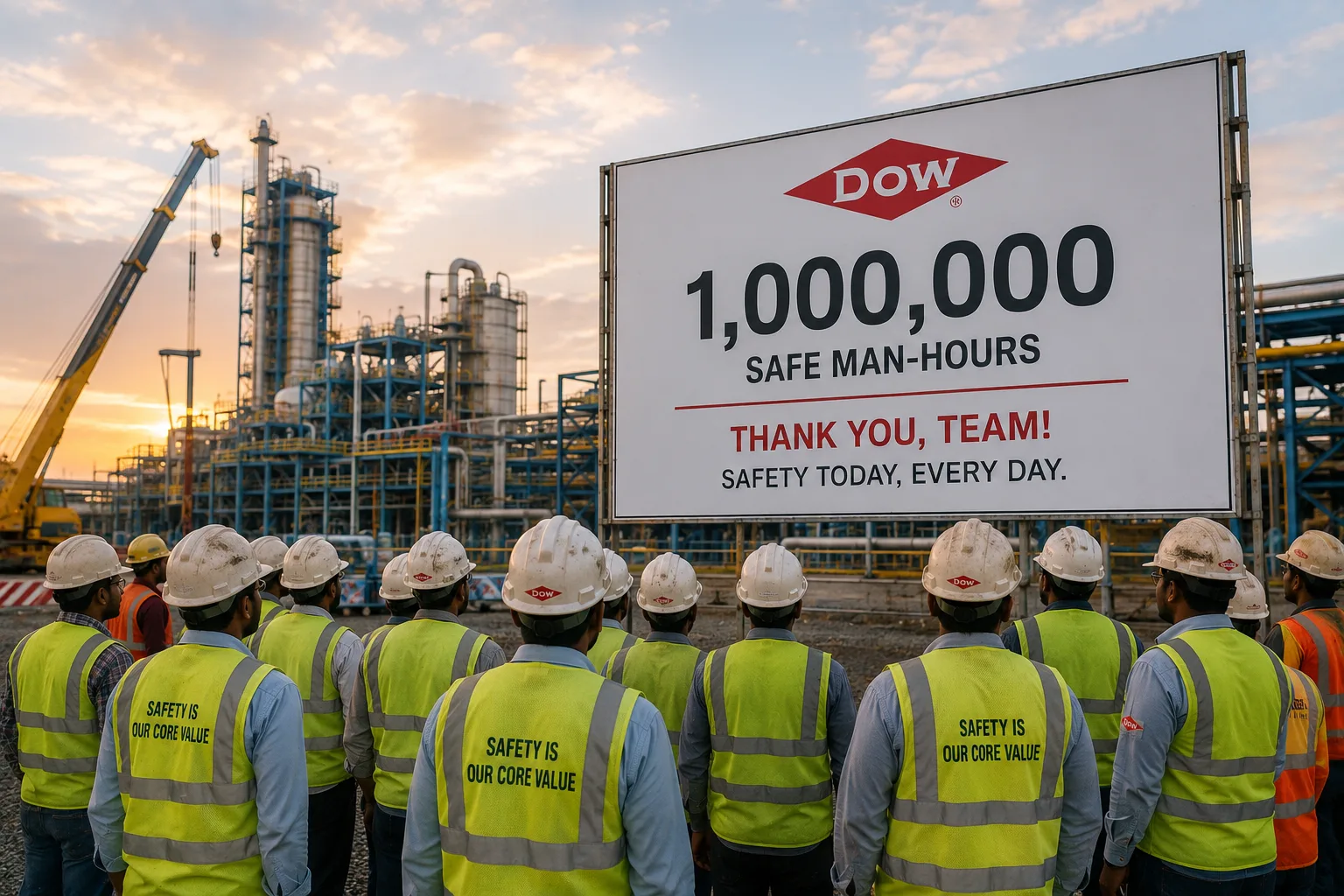
On an industrial project, safety performance is tested every day across manpower, lifting, work at height, civil activity, equipment movement and changing workfronts. Reaching one million safe construction man-hours at DOW was therefore a project-wide achievement, not just a statistical milestone.
The project for Dow Chemicals International Pvt. Ltd. at Lote MIDC, in Ratnagiri district, was one of the largest and most multidisciplinary that Creativve Constructiions has delivered. It covered around 2,50,000 sq.ft. of RCC and PEB buildings, MEP systems, interiors, roads, drainage and landscaping, with a workforce that reached around 250 people over roughly 16 months of execution, including about four months of Konkan monsoon.
Within that setting, the team achieved one million safe man-hours, an achievement recognised by DOW's senior team in India.
What one million man-hours represents
A man-hour is one person working for one hour. One million man-hours is the combined working time of everyone on the project, from labourers and masons to engineers and supervisors, accumulated shift after shift and day after day.
To put it in perspective, a workforce of a few hundred people working full shifts six days a week takes many months to accumulate that many hours. Every one of those hours involved some level of risk, and every one had to be managed. The milestone reflects consistent control of routine construction risk across changing activities, workfronts and people.
The risk profile of the project
The scope at DOW involved many of construction's highest-risk activities:
- Work at height during PEB erection, roofing, cladding and facade work.
- Heavy lifting of steel members, roofing sheets and materials.
- Excavation for foundations, drains, culverts and utilities.
- Concreting and formwork for RCC buildings.
- Road construction with heavy equipment and vehicle movement.
- Electrical and MEP installations.
- Interior works involving power tools and work on ladders and platforms.
All of this took place in a demanding climate, with heavy monsoon rain making surfaces slippery, excavations unstable and access more difficult. Working for a global chemical company also meant meeting high safety expectations throughout.
Safety planning alongside execution
A milestone like this is not achieved by inspection alone. Safety has to be planned into the work itself: the sequence, access arrangements, lifting plans, edge protection, temporary works and equipment choices. When the safe method is built into the plan, the site does not depend on someone noticing a hazard at the last moment.
On a project of this scale, with many activities running in parallel, that planning had to be continuous. Each new phase, from foundations to steel erection to roofing to finishes, brought new hazards and required new controls.
Worker induction and task training
Every person entering the site needed induction covering site rules, hazards, emergency procedures and the client's requirements. With a workforce of this size, much of it drawn from labour contractors and coming from different states and language backgrounds, induction had to be clear, practical and delivered in languages workers understood.
Beyond induction, high-risk tasks needed specific training: harness use for height work, rigging and signalling for lifts, safe use of power tools and equipment, and excavation safety. Daily toolbox talks kept attention on the risks of each day's work.
Permits, supervision and discipline
Permit-to-work systems for height work, hot work, excavation and electrical work confirmed that controls were in place before high-risk tasks started. Supervisors checked conditions on the ground and stopped work when they were not met.
Consistency mattered most. Over a million man-hours, the risk of complacency grows. Standards had to be applied as strictly in the last month as in the first, on quiet days as on days when the client visited.
Safety through the monsoon
Maintaining safety performance through about four months of Konkan monsoon deserves particular mention. Rain changes the risk on almost every activity. Steel members and roof sheets become slippery, so work at height on PEB structures needs extra care, and often has to stop during heavy showers or strong winds. Excavations take on water and their sides can weaken. Temporary electrical installations are exposed to moisture, raising the risk of shock. Site roads become muddy, affecting vehicle and crane movement. Visibility drops during heavy downpours.
Managing these risks requires daily judgement: deciding when conditions are unsafe for particular activities, keeping drainage and pumping arrangements working, inspecting temporary electrical installations more frequently, maintaining safe access routes and briefing crews on wet-weather hazards. A safety record that holds through a full Konkan monsoon reflects consistent attention on difficult days, not just good conditions.
Large workforce, consistent standards
With a workforce of around 250 people at its peak, many of them engaged through labour contractors and some joining partway through the project, keeping standards consistent was a continuous effort. Every new arrival needed induction. Every new subcontractor needed to understand the site's expectations. Supervisors had to apply the same rules to every crew, regardless of who employed them.
Recognition by DOW's senior team in India
The achievement was recognised by DOW's senior team in India. For the project team, this recognition carried real significance. DOW is a global company with demanding safety standards, and acknowledgement from its leadership confirmed that the project's safety performance met those expectations.
Recognition also matters for the workforce. It shows every worker that their daily discipline, wearing PPE, following permits, reporting hazards and looking out for each other, contributed to something meaningful.
What the milestone demonstrated
The value of the achievement is not only the number. It demonstrates that strong safety performance can coexist with industrial scale, a demanding programme and difficult weather when HSE is integrated into execution. Safety and progress are not competing goals. On a well-run project, they reinforce each other.
Creativve's Approach
For Creativve Constructiions, the one million safe man-hours at DOW remains an important reference point. It showed what is possible when planning, training, supervision and worker participation work together over a long and complex project. The practices behind it are carried into every industrial project we undertake, with the same objective: every worker goes home safely, every day.